Esashi's story

Japan Heritage story

Even Edo is not as busy as Esashi in May
-The town made prosperous by herring-

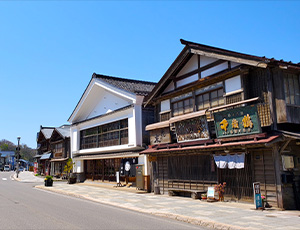
On the street passing through the lower terrace of town, along the Esashi coastline, there is a line of kirizuma-yane (gable roof) buildings.
The yago (house trademark) is posted on the noren (traditional shop curtain), signboard, and walls of each buildings.
Due to each warehouse gradually descending towards the seaside, it appears as if they are a staircase, living alongside the sea.
This street was formed due to the herring fishing industry, and its products were processed here from the Edo period through to the Meiji period,
coining the phrase 'Even Edo is not as busy as Esashi in May.'
The prosperity brought about by the herring industry, along with the culture passed down since the Edo period, continues to be evident throughout the area, even today.
The origins of prosperity that surpassed that of Edo

Chapter 1

Esashi's Historic Town

Esashi’s Historic Town is nestled neatly along the coastline.
Within it is Ubagami Shrine. The shrine was built by Esashi's townspeople to honor the statue of a god and to hold festivals. The statue belonged to Ori, a mythical figure said to have brought herring to Esashi.
Esashi was largely built by merchants from the main island of Honshu who came for the herring trade in the 18th-19th centuries.
Two notable examples of this are The Yokoyama House which was built by merchants from Ishikawa pref. in the 18th century, and The Former Nakamura Family Merchant House that was built by merchants from Shiga pref. in the 19th century. The trademarks of these merchants were displayed from the facades of their shops/warehouses and are still visible today.
Take a walk along The Historic Town and you can still experience the echoes of Esashi’s prosperous past.

Chapter 2

Nurturing and Displaying Culture

As Esashi flourished, people came from around the country via the northern trade routes, bringing with them various cultural customs. Esashi’s townsfolk adapted these customs to suit their local environment, creating something entirely unique.
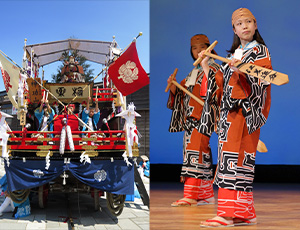
One example is a folk song inherited from the 18th century, Esashi Oiwake. Originating with horse drivers from Nagano Pref. it came to Esashi by land and sea. Once here, the lyrics were changed to reflect Esashi's winds and waves, ensuring it endures to this day.
The Ubagami Togyo Festival takes place in August using portable shrines and floats from the 18th century. It is held to pray for bountiful seas.
Folk performances like Esashi Okiageondo pass on the passion of herring fishing.

Chapter 3

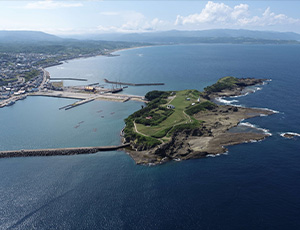
The Island that Birthed Prosperity

According to legend, an old woman called Ori was given a bottle filled with water by the gods. She poured the water into the sea at Kamome Island causing herring to come to Esashi in great numbers. Later, she threw the bottle in too, creating Heishi Rock.The herring that Ori brought to Esashi led to immense prosperity.
As trade of herring and herring products increased, scores of people came to Esashi along the northern trade routes. They moored their ships behind Kamome Island to protect themselves from raging seas leaving deep holes in the island's cliff face.
The crews of these ships would climb steps up the island to pray for a safe voyage at Itsukushima Shrine. Along with the townsfolk, they built food stalls and enjoyed banquets while listening to Esashi Oiwake. The Remains of Merchant Ship Mooring, Itsukushima Shrine, The Remains of Stairs Up Kamome Island, and The Remains of the Banquet Site can all be seen on Kamome Island.

『Matsumae Byobu』Hakodate City Central Library